MARCH 2026
Inspector Merer’s Diary: Operational Proof of Khufu’s Hydraulic Construction System
For decades, I maintained four foundational claims about the Great Pyramid’s construction. These claims guide my hydraulic construction theory:
1. A Western Branch of the Nile flowed beside the Giza Plateau during the Old Kingdom.
2. A dam at Ro-She Khufu retained floodwater inside Khufu Basin.
4. Stones were floated through canals and sluices — not dragged across desert ramps (Challenges and Rebuttals #7).
Today, geological core samples, satellite reconstructions, and Merer’s operational logbook converge.
What was once dismissed is now documented.
The Discovery of Inspector Merer’s Diary
On March 12, 2013, at Wadi el-Jarf on Egypt’s Red Sea coast, Professor Pierre Tallet discovered the oldest known papyri in the world. These documents were written by an official named Inspector Merer and represent a rare contemporary written record from the period of the Great Pyramid’s construction.
Inspector Merer was directly involved in work connected to the construction of Pharaoh Khufu’s (second ruler of Egypt’s Fourth Dynasty) funerary complex at Giza. Although Merer was not an architect or master builder, his position as an inspector responsible for daily logistics places him in direct operational contact with construction activities. His papyri, therefore, provides contemporaneous written testimony rather than a historical account.
The papyri records cover slightly more than one calendar year, most likely corresponding to the 26th and 27th year of Khufu’s reign. The text begins after the 13th census of large and small cattle, a biannual event conducted for taxation purposes. Because Egyptologists continue to debate whether the first census occurred in Khufu’s first or second regnal year, the absolute dating remains approximate.
The papyri, describe the activities of a work-gang composed of approximately 160 men. The work-gang was divided into four phyles (derived by Greek meaning “tribe” or “za” in Egyptian). Each phyle consisted of forty men assigned to a single boat and supervised by its own inspector. Inspector Merer was responsible for one such boat and phyle of forty men. His duties included overseeing daily work and maintaining a written log recording activities, travel routes, and overnight locations. Comparable daily logbooks were kept by inspectors supervising the other boats, demonstrating a highly organized administrative system with extensive record-keeping requirements.
The logbooks from Wadi el-Jarf describe the organization and responsibilities of Khufu’s work-gang during a defined annual interval at Giza. Importantly, these records emphasize water-infrastructure management and logistical transport, rather than stone hauling via inclined planes. The activities attributed to the work-gang are consistent with a hydraulically managed construction environment, in which canals and artificial basins functioned as active components of material movement and labor deployment.
As summarized by Tallet and Lehner:
“From the details given in the logbooks it is possible to piece together a picture of the various activities that the work-gang (aper), and its different sections (phyles), undertook through the year. In the period covered, the work gang was initially operating in the Giza region, from the last month of year 26, i.e. the year of the 13th census of Khufu (fourth month of the Shemu season—probably June) until November of the following year (first month of the Peret season). At that time it was responsible for the transportation of the labour force, the maintenance of a system of canals and artificial lakes …”
— Pierre Tallet & Mark Lehner, The Red Sea Scrolls (Thames & Hudson), p. 166.
The consistent pairing of each phyle with a boat indicates that waterborne movement was routine rather than incidental.
The Western Branch of the Nile — From Hypothesis to Confirmation
The ancient Egyptians were masters at handling water. With incredible skill and creativity, they constructed one of the most significant structures in history by harnessing the surrounding water. Transportation in ancient Egypt was fundamentally waterborne. Archaeological remains of canals, texts, and drawings attest to the vast, organized system of waterways. There is textual evidence that Pharaohs commissioned canal excavations, further proving that all of ancient Egypt was interconnected by water canals. These canals served a dual purpose: they functioned as primary transportation routes and as life-sustaining sources of water. The Nile was not simply a river; it was Egypt’s logistical backbone.
It has been said, “Without of Nile there would be no Egypt.” To that statement I added“Without of Nile there would be no Egypt, and without water from the Nile, there would be no pyramids.”©.
In modern times we rely on air, road, rail, and water transportation. In ancient Egypt, transport was overwhelmingly dependent on water. Transportation on land was comparatively inefficient. To suggest that the builders of the Great Pyramid routinely dragged 60-ton stones across sand and up inclined ramps is comparable to asking a modern truck driver to haul a fully loaded semi-trailer across an unpaved farm field instead of using a highway. It sounds absurd because by using the highway it is faster and easier. The question in both cases is the same: why choose the most difficult method when a more efficient one is available?
The ancient Egyptians were intelligent, practical engineers. They observed that during the annual inundation, boats, regardless of how heavily loaded, rose effortlessly with the water level. This natural principle demonstrated that water could lift immense weight. It is entirely reasonable to conclude that such observations inspired the controlled use of water in smaller enclosures, which we now call sluices, to raise heavy loads in a controlled manner.
Rather than fighting gravity across desert terrain, Egypt’s builders likely worked with the Nile — using water buoyancy instead of relying solely on brute strength.
The organizational structure described in Merer’s logbook aligns with a canal-and-sluice environment, in which controlled water levels allow boats to function as primary logistical platforms for transporting labor and materials. The explicit association between labor transportation and the maintenance of dam, canals, and artificial lakes is significant. Ramp systems—whether straight, zigzag, or spiral—require no such hydraulic infrastructure, nor do they necessitate seasonal water management extending across both Shemu and Peret seasons . By contrast, a canal-and-basin system used to float stones in canals and sluices would demand precisely the kind of continuous maintenance, dredging, and water-level regulation (dam) described here and in my theory.
The logbooks, therefore, support a construction environment in which waterborne logistics played an operational role, aligning with a sluice controlled canal model rather than a purely earthbound ramp-based mechanism.
Merer’s Logbook:
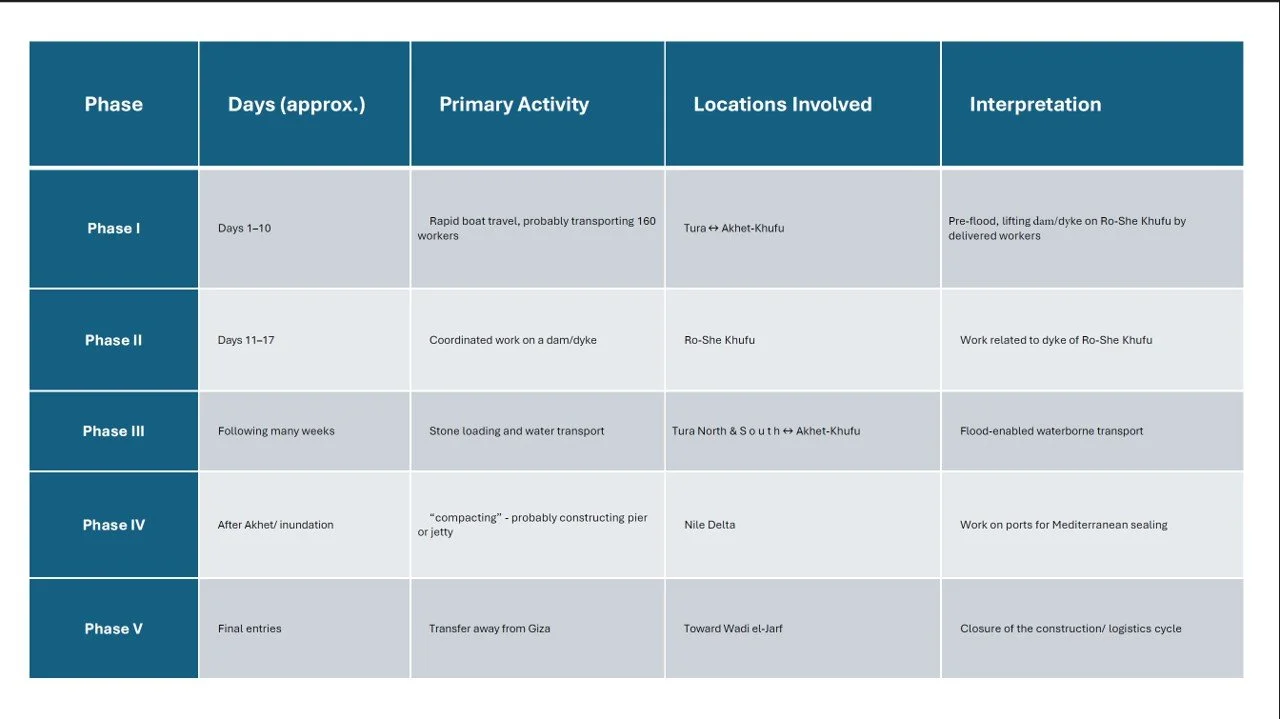
According to Inspector Merer’s logbook, the first ten days of recorded activity consist of rapid travel between Tura and Akhet-Khufu without the transport of stone. This phase occurred before the arrival of the annual Nile flood at the Giza Plateau. The absence of stone cargo and the speed of travel suggest that Merer’s initial task was not material transport.
It is most likely that during this period Merer was delivering workers assigned to labor of the Dam at Ro-She Khufu. This interpretation is supported by later entries stating that Merer worked in coordination with fifteen phyles, approximately 600 men, on dam-related activity. One entry records: “Day 11: Inspector Merer spends the day with [his phyle in] carrying out work related to the dyke of Ro-She Khufu.”
Once personnel had been delivered and this stage of dam maintenance was concluded, Merer’s primary responsibility for a considerable period of time shifted to overseeing the transport of white limestone from Tura North and Tura South to the Great Pyramid. Most likely the majority of this stone was used for the outer casing of the Great Pyramid, with some used in interior chambers and in associated structures, including the causeway, upper temple, and the Khufu Harbor Temple (also known as the Khufu Valley Temple). When boats were loaded with heavy stone, travel was slower, and each round trip between Tura and the pyramid required an additional day. These stone deliveries occurred after the arrival of the flood, when water levels were sufficient for heavily laden boats.
The final entries in Merer’s logbook record his transfer to the Red Sea port at Wadi el-Jarf, where the papyri were ultimately discovered. These documents were intended to be returned to a central administrative office for archiving, where they would have been used to track work progress and calculate labor compensation, which was paid in goods. The fact that the papyri remained at Wadi el-Jarf suggests that the records were no longer required, possibly due to the death of Pharaoh Khufu.
The ancient Egyptian calendar was a solar calendar of 365 days, divided into three seasons—Akhet (Inundation), Peret (Growing), and Shemu (Harvest)—each consisting of four months, totaling 12 months per year. Months were divided into three ten-day periods, with a five day festival period added at the end of the year. The Egyptians were great astronomers. The reappearance of the star Sirius, just before dawn marked the beginning of the New Year and closely coincided with the onset of the Nile flood.
As recorded in the papyri, Merer’s second major assignment involved work at Ro-She Khufu described as “lifting the piles of the dyke.” This phrase refers to the physical removal or dismantling of the dam/dyke structure. This work was carried out immediately before the arrival of the new inundation and most likely involved removing the lower portion of the previous year’s dam. Such an action would have prepared the hydraulic system to accommodate large, deep boats delivering heavy stone to storage areas near the Sphinx once floodwaters arrived.
The Dam of Ro-She Khufu — Direct Logbook Evidence
While Egyptologists have interpreted this action as allowing Nile water to flow INTO the Khufu Basin, my interpretation is that it allowed water to flow OUT of the basin. At the end of the Shemu season, Nile water levels were at their annual minimum, while residual water retained in the Khufu Basin from the previous inundation would still have been higher.
Removing the base of the dam/dyke at this time would permit drainage of the basin into the Western Branch of the Nile. At this point the Dam was 100% open.
During the preceding months, basin water levels would have gradually declined as water was used in canals and sluices to float stones, and losses occurred through evaporation and seepage.
Annual Nile flooding in ancient Egypt began at the start of the New Year and always originated in Upper Egypt, at the border with Nubia. The inundation was caused primarily by intense summer monsoon rains in the Ethiopian Highlands along with melted snow, which greatly increased the Nile’s volume and carried fertile silt downstream. As floodwaters moved northward, water levels at the Giza Plateau rose by approximately seven meters above the annual low-water mark.
Because the Nile flood advanced gradually from south to north, it did not reach Lower Egypt immediately. Based on the speed of the water in the river and the distance involved, it would have taken approximately 10 to 14 days for floodwaters to travel from the southern border with Nubia to the Giza region/Khufu Basin. This interval corresponds to the period recorded in Inspector Merer’s logbook during which he delivered people and worked with fifteen phyles, approximately 600 men, on dam/dyke-related activity at Ro-She Khufu. This timing strongly suggests that the dam/dyke work was coordinated with inundation and that Merer’s 15 phyles worked to lift the bottom of dam and prepare this dam for closing at the end of inundation, as I described in Project 3 on the website.
In Merer’s logbook the word that Professor Pierre Tallet translates as dyke is the Egyptian term denit (dnjt). I believe the appropriate translation for the word denit in this context is dam. The word denit is typically represented with the determinative for a body of water or an earthen structure related to irrigation. In Tallet’s official publication of the papyri, he uses the French word digue, which can mean both dyke and dam. In English translations, this often becomes dyke, referring specifically to the structures at Ro-She Khufu (the Entrance to the Lake of Khufu) used to manage water levels for the artificial basin.
I proposed and Inspector Merer’s writings confirmed, that the Egyptians constructed a dam within the Khufu Basin to retain floodwater and extend waterborne transport well beyond the natural inundation season. This retained water was then used throughout the year to move stone by floating it through canals and sluices, a method well suited to heavy loads and large construction volumes. The dam, I argue, formed an integral part of the Ro-She Khufu complex.
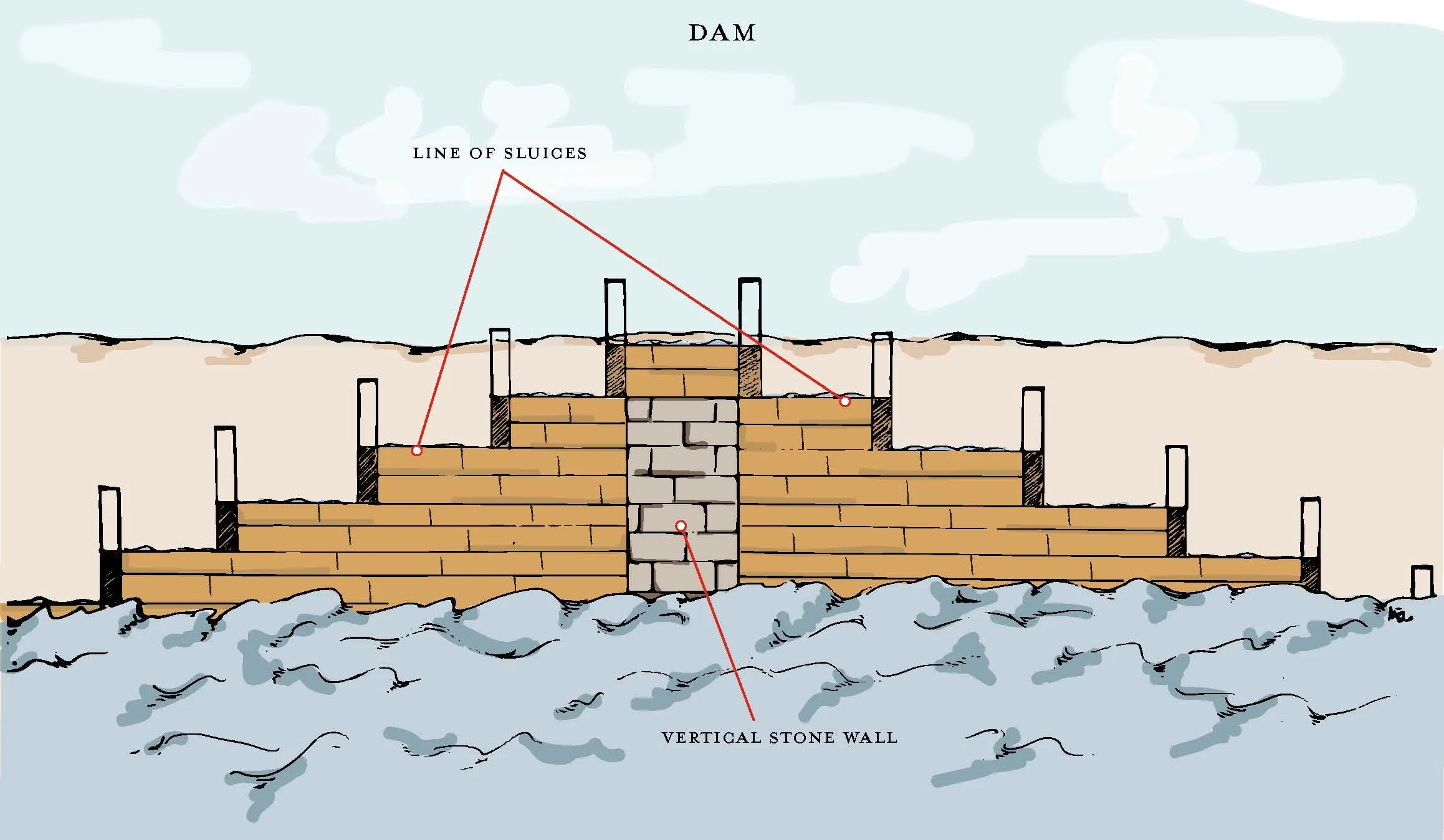
The delivery of heavy stone—such as granite from Aswan and white limestone from Tura—took place primarily between July and the end of October, during the high-water season. At the end of the inundation, the dam at Ro-She Khufu would have been closed to retain elevated water levels within the Khufu Basin. Even after closure, boats operating in the Western Branch of the Nile could continue to deliver smaller stone blocks and supplies to the base of the dam, where sluices on either side allowed cargo to be lifted into the basin and transported onward by water to construction areas.
Egyptological explanations do not address the needs of this dam. A dam was not required for stone transportation, to supply food or labor to the Giza Plateau, nor was it necessary for the construction or use of ramps, which dominate most traditional models of pyramid construction. This raises a fundamental question: why was a dam built at this specific location?
The most coherent answer is that the dam was needed to dam water. The purpose was to retain water within the Khufu Basin, enabling year-round water transport and the controlled flotation of stone through canals and sluices. Without such a hydraulic system, the sustained movement of massive stone blocks required for pyramid construction would have been far more difficult or impossible. In this view, water management was not auxiliary but essential to the construction process. Without this water, there would not be a Great Pyramid.
I copyrighted my theory in 1986, proposing that water-based transport played a central role in pyramid construction. Shortly after obtaining the copyrights, I had a meeting with a Chicago-based Doctor of Egyptology, who questioned how water and stones reached the Great Pyramid when the Nile is several miles to the East. At that time, I asserted that the Western Branch of the Nile (YES, I used that name - Western Branch of Nile) flowed beside the Giza Plateau in ancient times and that the stones floated in canals and sluices from all over Egypt to the top of the Great Pyramid. That Egyptologist dismissed my theory.
Inspector Merer’s logbooks confirm what I have theorized for many, many years (and what Dr. Mark Lehner later discovered - this branch in the Old Libeini Canal), that the Western Branch of the Nile flowed adjacent to the Giza Plateau during the Old Kingdom, providing direct water access to the construction zone.
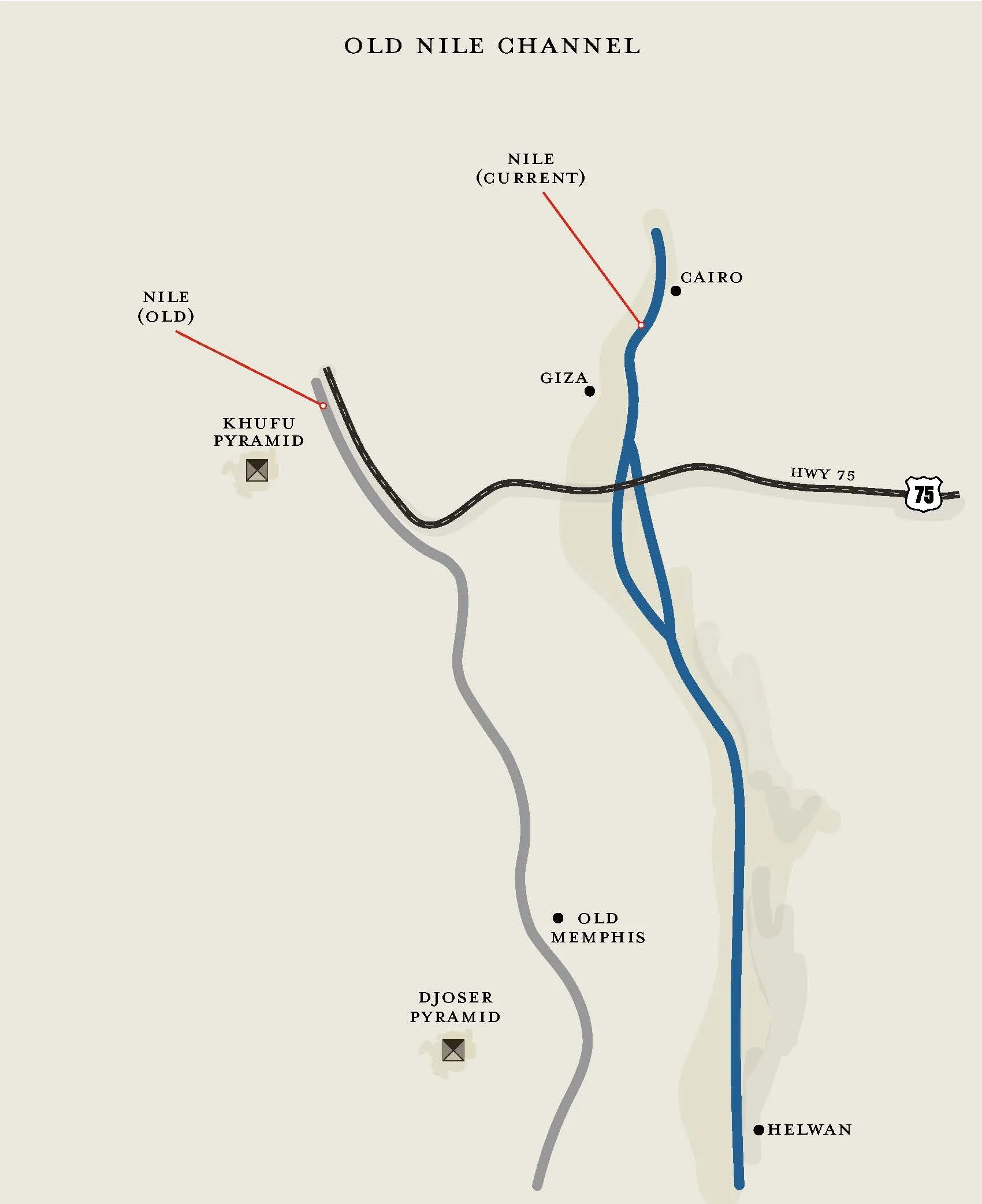
Inspector Merer's Diary, subsequent geological and archaeological research has since confirmed the existence of the Western Branch of the Nile, validating a key premise of my theory.
Inspector Merer records sailing “upriver” and “downriver” between Tura — Akhet-Khufu — Tura. This directional navigation indicates movement along a flowing Nile distributary — not a stagnant artificial canal.
Sediment cores west of the present Nile channel identified Nile-derived silts and clays in the Old Libeini Canal next to Giza Plateau. These sediments originated in the Ethiopian and Sudanese highlands — confirming former Nile flow adjacent to the plateau.
In August of 2022, the National Academy of Science published an article titled “Nile waterscapes Facilitated the Construction of Giza Pyramids During the 3rd Millennium BCE.” The article was based on research led by geographer Hader Sheisha, who attempted to reconstruct the appearance of the Nile River in ancient Egypt. As mentioned, I copyrighted my theory in 1986, since then, I have known there must have been a branch of the Nile that flowed next to the Giza Plateau. Hader Sheisha’s findings confirm my theory and what Dr. Lehner discovered.
In 2023, Dr. Eman Ghaneim and her team presented their research to the 13th Congress of Egyptologists about the rediscovery of the dried-up branch of the Nile River, renaming it the Ahramat Branch (Pyramids Branch in Arabic). An article about this re-discovery was published on November 29, 2023. IFL Science… “Space discovery shows that the pyramids were built using water.”
In 2020, two years before the publication of the NAS article, I sent approximately 600 emails to inform academics and every single person listed in the Directory of North American Egyptologists about my theory, “Secrets of the Pyramids”. In these emails, I introduced my theory and Project 3 - “Water Transportation at Giza”, which focused on the water transportation system used during Khufu's reign. According to my theory, the Western Branch of the Nile, located adjacent to the Giza Plateau, was the source for a system of waterways built and used by Egyptians to transport building materials and supplies within the Giza Plateau.
In Project 3 - Water Transportation at Giza, I stated that every pyramid (not 31) in ancient Egypt was built near a river, lake, or water basin with a harbor, and each pyramid had a causeway that led down from the pyramid to the temple in the harbor. The temple at Khufu Harbor is known as the Valley Temple, but I suggest using a more appropriate name, the Khufu HARBOR Temple*, due to its location. You may wonder why I named it the Western Branch of the Nile. That's because the main Nile River is located several miles to the East.
I’m happy to see that researchers are researching my website, too.
What I have been saying for many, many years - The existence of a Western Nile branch during Khufu’s reign is now supported by sedimentology, remote sensing, and primary text.
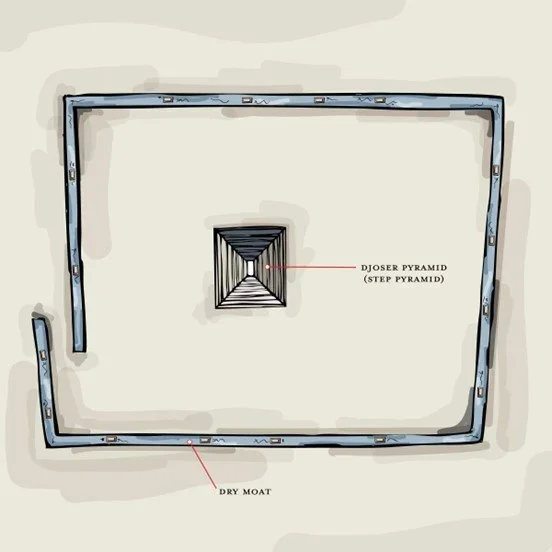
Inspector Merer’s logbook provides rare eyewitness testimony that aligns closely with my hydraulic interpretation. When combined with additional archaeological features now uncovered, such as the Dry Moat surrounding the Step Pyramid, the evidence strongly supports a water-based construction system (which is the fundamental component of my theory). The search for direct evidence of sluices continues, but the fundamental proof that a water-based construction system was the driving force behind pyramid construction has been well documented and should no longer be considered an alternative theory.
The Khufu Basin: Ancient Port
Ro-She Khufu, whose name can be translated as “the mouth (or entrance) of the Lake of Khufu/ Khufu Basin,” likely functioned as a regulated port authority. Boats entering the basin most likely would have been required to stop, report their cargo, and undergo administrative processing, reflecting the high level of bureaucracy documented in Old Kingdom Egypt. This process would have slowed down every boat entering the Khufu Basin. During peak construction periods, the Khufu Basin may have resembled a present day multi line highway in rush hours with stop and go traffic. Like slow sailing boats in the clip from the video I created outlining my theory, vessels delivered timber from Lebanon, granite from Aswan, limestone from Tura, basalt from Faiyum, copper from the Sinai Peninsula, as well as food, tools, and workers from across Egypt. Such a system would have required careful hydraulic control, centralized administration, and continuous maintenance—precisely the activities recorded in Merer’s logbooks.
In Project 3 , I proposed that the primary storage area for white limestone and granite was located near the Sphinx, which had already been carved during Khufu’s reign. This area likely served as the final delivery point for Inspector Merer’s transport operations. Within the Khufu Basin, this zone also appears to have been the deepest section, corresponding to what is identified in my video as the Probable Small Lake.
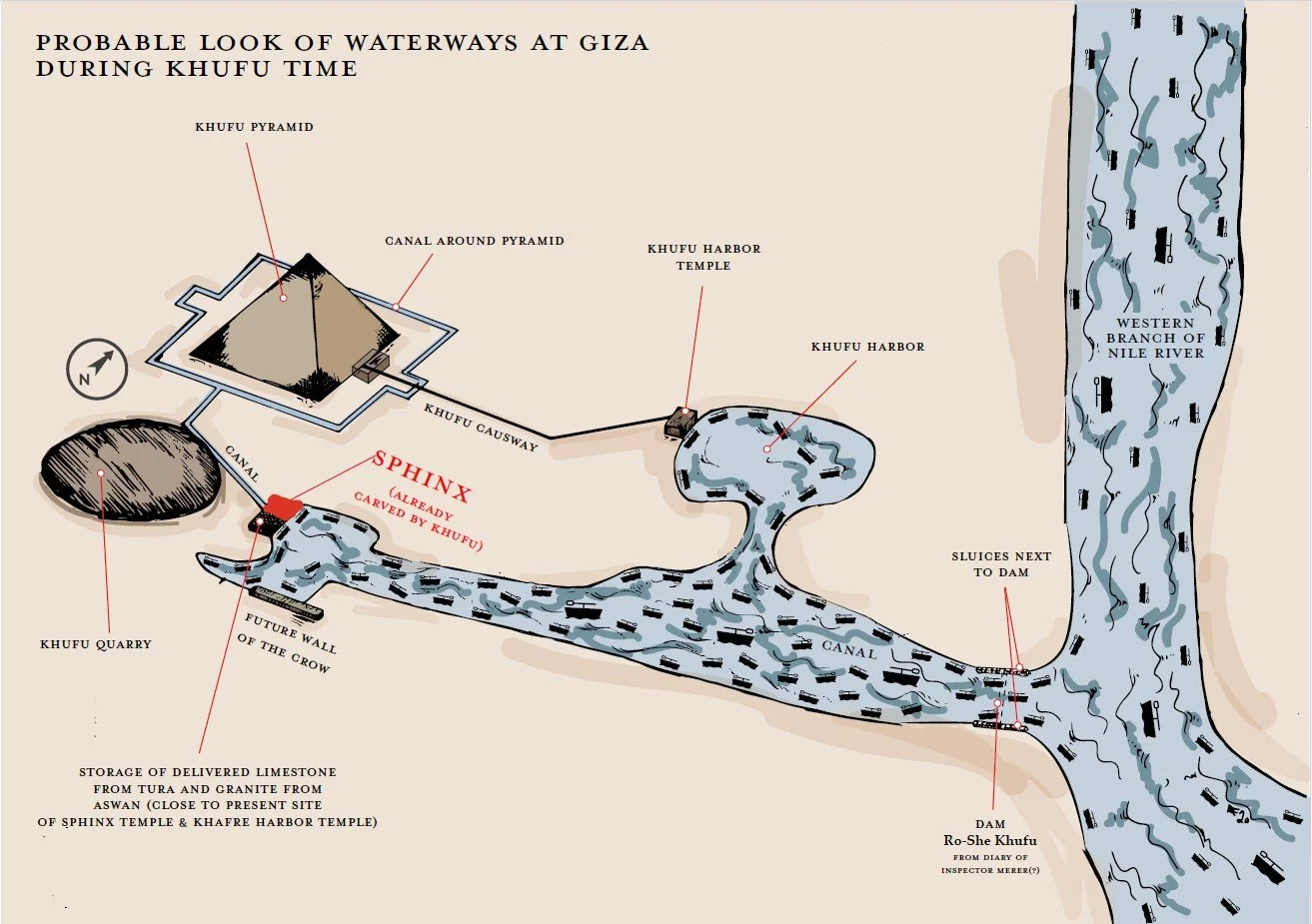
From this storage area, stone blocks were reloaded onto barges and transported through canals and sluices to the base of the Great Pyramid and onward to the required construction levels. This system would have allowed stone to be moved efficiently by controlled water-level flow rather than being dragged over land.
Both in the storage area near the Sphinx and at the Khufu Harbor Temple (also known as the Khufu Valley Temple), archaeological remains include low-angle water ramps. These features are consistent with fluctuating water levels within the Khufu Basin. Rather than serving as hauling ramps, their gentle incline is better explained as an adaptation to changing water heights, allowing boats to load and unload stone as basin levels rose and fell.
Sluices — The Nile Was the Teacher
Every year during Akhet season, the Nile raised boats and their cargo effortlessly. If water levels can be controlled within confined enclosures, heavy cargo rises and falls with it, which is the principle of a sluice. Controlled hydraulic elevation was known in antiquity.
Did Khufu’s engineers understand how to raise heavy stones using controlled water levels? YES! I believe they did. As discussed in Challenges and Rebuttals (#7), the principle behind sluices was not an abstract invention — it was demonstrated annually by the Nile itself.
Every year during the season of Akhet (inundation), the Nile rose dramatically. Boats floating on its surface. regardless of the weight of their cargo, rose effortlessly with the water level. A vessel carrying timber, grain, or even heavy stone did not need to be “lifted” by manpower. It rose automatically because buoyancy does not depend on the weight of the cargo, but on displacement.
For thousands of years, the people living along the Nile observed this phenomenon: water lifts what floats upon it.
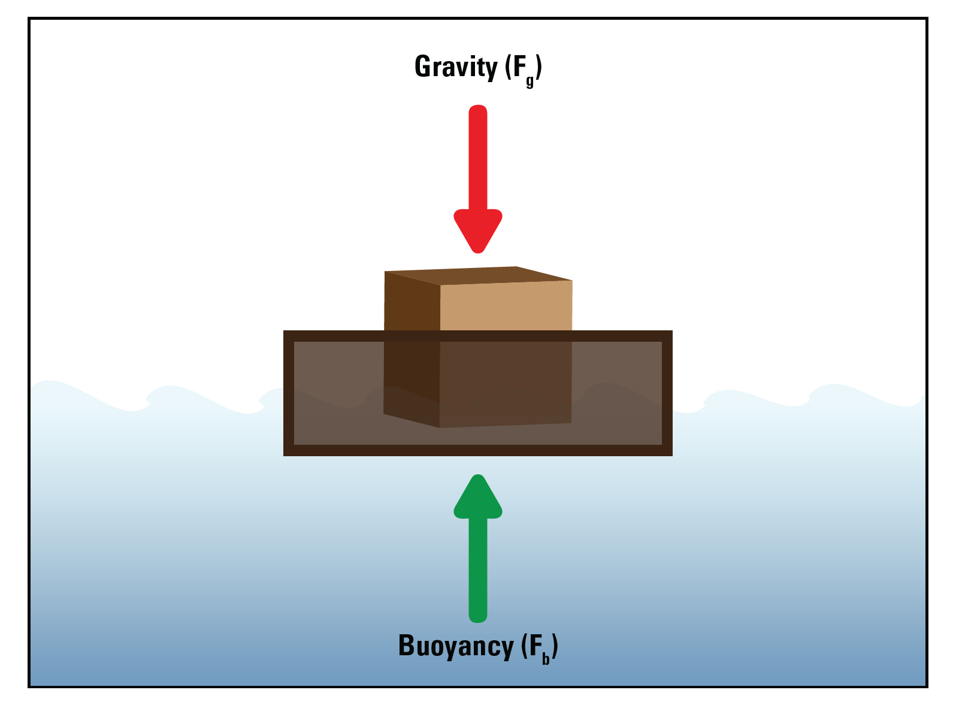
From this natural principle comes a logical engineering extension: if rising water can lift a heavily loaded boat in the open river, then controlled water levels within enclosed basins could raise boats, and their cargo, in a predictable and repeatable way.
A sluice is simply a confined space in which water levels are deliberately controlled. When water is introduced into such an enclosure, any floating vessel within it rises accordingly. When water is released, it descends.
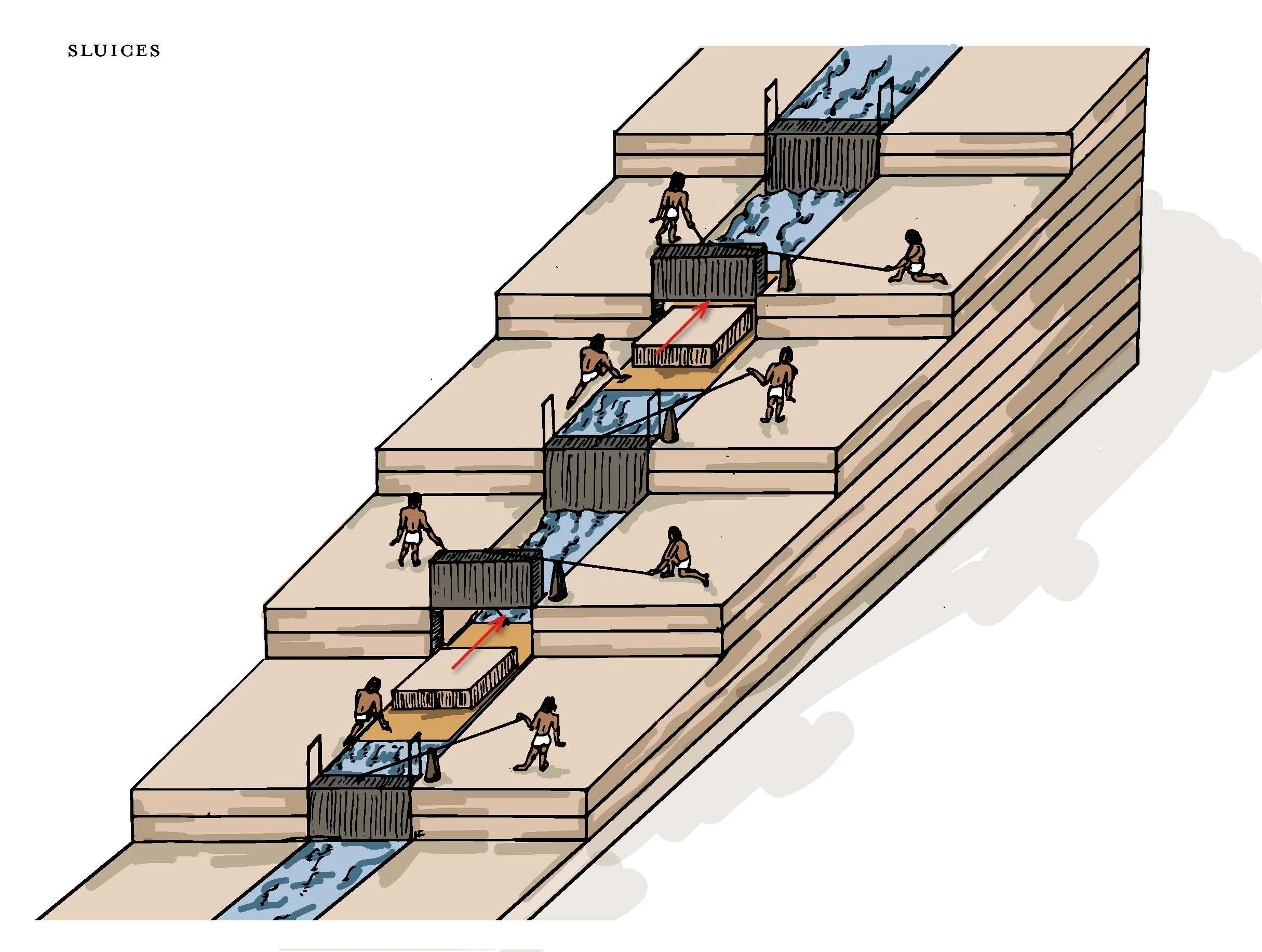
The Nile itself demonstrated the concept. The Egyptians did not need to invent buoyancy — they witnessed it every year. The river was their teacher.
If heavy stones were transported on barges within canals connected to a controlled basin system, then lifting those stones was not a matter of dragging them upward against gravity across sand. It was a matter of allowing water to do what it naturally does.
The small controlled enclosures used to regulate water levels are what we now call sluices. The floating platforms that carried stones were barges. Water was the mechanism of elevation.
The earliest classical reference to controlled water-management structures in Egypt appears in the writings of Diodorus Siculus (Bibliotheca historica, Book I, 30–41). He describes efforts to construct a canal linking the Nile to the Red Sea under Necho II and later Darius I, both of whom reportedly abandoned the project due to concerns about flooding and water-level differences. According to Diodorus, Ptolemy II Philadelphus (reign 284-246 BC) later completed the canal and implemented water control measures—likely in the form of gates or sluice-like structures—to regulate navigation.
Inspector Merer’s diary provides:
• Direct textual evidence of a Nile branch next to the Giza Plateau
• Explicit reference to a dam/dyke at Ro-She Khufu
• Documentation of canal and basin maintenance
• Water-coordinated stone transport
It is time to look at the role of water in pyramid construction as the key methodology. Merer’s logbooks support a construction environment in which waterborne logistics played an operational role, aligning with a sluice controlled canal system.
Egyptologists must consider the evidence….
Without the Nile, there would be no Egypt, and without water from the Nile, there would be no pyramids. ©